WHAT IS IT?
A stress echocardiogram is also known as a dynamic echocardiogram or dynamic ultrasound of the heart. It is a test used to assess the function of the heart, the heart valves, and the coronary arteries.
HOW IT WORKS
The test can be performed either through exercise (on a treadmill or stationary bike) or with medication. During the test, your doctor monitors your blood pressure and heart rate while taking ultrasound images. When your heart rate reaches its peak, the ultrasound images from all stages are compared. This allows us to determine whether the heart walls are receiving enough blood and oxygen during periods of high demand or if there is variability in valve function.
At the clinics CarE MediC stress echocardiograms are performed on a reclining exercise bike or with medication.
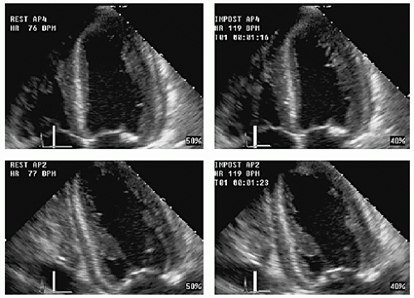
WHEN DO I DO IT?
Your cardiologist may recommend a stress echocardiogram if, for example, you have angina (chest pain that may be caused by coronary artery disease) or impending valvular heart disease that may require treatment. It also helps determine how much exercise you can safely tolerate if you are undergoing cardiac rehabilitation. Information is also gathered on how well you respond to treatments such as coronary artery bypass grafting (CABG), angioplasty, and antianginal or antiarrhythmic medications. Finally, the “viability” of the myocardium is assessed, which provides essential information regarding the prognosis and potential revascularization—revascularization—in patients with chronic coronary artery disease or a recent myocardial infarction.
TYPES OF STRESS ECHO
Exercising on a treadmill
Ultrasound imaging should be performed at rest, at peak exertion, and during recovery, when feasible. It preserves the normal electromechanical response and can provide important prognostic information regarding functional status. It is recommended for individuals who are able to exercise.
Exercising on a stationary bike
Ultrasound imaging is feasible at rest, during all stages of fatigue, at peak fatigue, and during recovery. As with treadmill testing, it preserves the normal electromechanical response and can provide important prognostic information regarding functional status. It is recommended for individuals who are able to exercise and offers advantages in the evaluation of diastolic dysfunction and valvular heart disease, while it also allows for the assessment of coronary reserve, just as in pharmacological stress echocardiography.
Pharmaceuticals (DSE)
Ultrasound imaging can be performed at rest, during all stages of exercise, at peak exertion, and during recovery. It is recommended for individuals who are unable to exercise and is the most common method for assessing myocardial viability.
LATEST INFORMATION
According to the latest guidelines from the American Society of Echocardiography—January 2020—the following applies to the various types of stress echocardiography:
• Stress echocardiography with exercise is more natural than pharmacological testing and provides the prognostically significant finding of the patient’s exercise capacity. Therefore, if a patient is able to exercise, this is the preferred method. (Recommendation Class I, Level of Evidence A)
• Stress echocardiography using a stationary bicycle (in an upright or supine position) is technically more feasible for evaluating both coronary reserve and for diagnosis.
• The DSE is the preferred alternative test for evaluating myocardial ischemia when the patient is unable to exercise.
• Diagnostic endpoints include reaching at least 80% of the maximum heart rate predicted for the individual’s age and sex.
